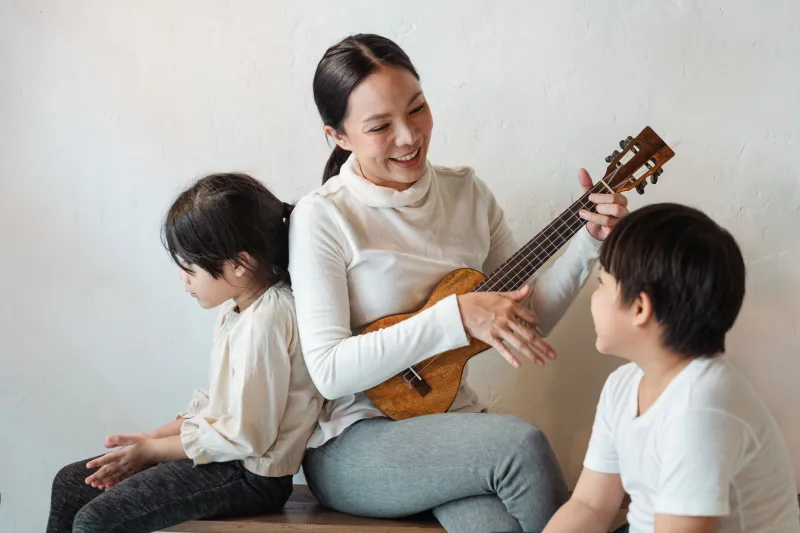
The Extra Chair Question: Watching a Boston Music Lesson Without Taking Over

Photo by Photo by Vitaly Gariev on Unsplash on Unsplash
Walk into almost any Boston lesson studio and you’ll see the same piece of furniture: a chair near the door. Sometimes it’s for a parent. Sometimes it’s for a coat. Sometimes it’s a silent test of whether the adult in the hallway is going to settle in for the whole half hour.
In 2026, as families juggle drop-offs, practice logs, and after-school schedules, the question of whether to watch a music lesson has become its own small etiquette puzzle. Teachers in Jamaica Plain, Somerville, Allston, and the neighborhoods in between tend to agree on one thing: observation is not a yes-or-no issue. It’s a conversation about age, temperament, and what the lesson is actually trying to accomplish that week.
The Chair Is Not the Default
A lot of parents assume the chair by the door is an invitation. Often it’s just a chair. Some teachers welcome an adult in the room, especially for beginners. Others find that a parent’s presence changes how a student experiments, makes mistakes, or talks back to the teacher. Neither approach is wrong, but the mismatch can feel uncomfortable if nobody names it.
The simplest move is to ask before the first lesson, not halfway through the third one. A short message works: “I’d like to sit in for the first few minutes to see how things go. Is that okay, or would you rather I wait outside?” That gives the teacher room to say yes, no, or something in between. It also signals that you’re not planning to coach from the chair.
Some Boston studios have open-door weeks or periodic parent observation days. Others prefer a quick check-in at the end of each lesson. If your teacher has a policy, treat it like the lesson schedule: useful information, not a personal verdict.
What Helpful Involvement Actually Looks Like
Teachers often say the most helpful parent is the one who is present without becoming a second instructor. That means listening, not correcting. Taking a note for home, not interrupting to say the rhythm is wrong. Saving questions about practice strategy for the last two minutes or a separate email.
One local piano teacher describes the ideal observer as “a quiet witness with a good poker face.” That’s a high bar, especially when your child is playing a piece you’ve heard them practice forty times. But the lesson is one of the few places where a student gets to work directly with an expert. A parent who jumps in can accidentally turn the studio into a group lesson with uneven authority.
Helpful involvement also looks different by age. For a six-year-old, staying in the room may be reassuring, and the teacher may want you there to learn the practice routine. For a nine-year-old, a drop-off with a five-minute check-in at the end might be the right balance. For a teenager, the best support might be asking, “Do you want me to come in, or should I pick you up after?” and accepting the answer.
Scripts for the Awkward Middle
Observation gets tricky when nobody wants to be rude. Here are a few low-friction ways to handle common moments.
When you want to observe but aren’t sure about the policy: “I don’t want to distract from the lesson. Would you prefer I wait outside, or is it helpful for me to watch today?”
When your child asks you to leave: “That’s fine. I’ll be right outside. I’ll ask the teacher for one thing we can work on at home.”
When the teacher invites you to stay and you can’t: “I’ll sit in for the first five minutes, then I’ll step out so you two can work.”
When you have a concern mid-lesson: save it. Write it down. Ask at the end: “I noticed they’re rushing the third measure. Is that something I should reinforce at home, or leave to you?”
These scripts aren’t magic. They just keep the focus on the student instead of the adult’s uncertainty.
When Your Child Plays Better — or Worse — With You There
It happens. Some kids light up with an audience. Others freeze, go silly, or suddenly forget where middle C lives. Both reactions are normal, and neither is a reason to cancel lessons or stage an intervention.
If your child performs better with you watching, enjoy it but don’t make it the standard. The goal is for them to feel capable whether or not you’re in the room. If they perform worse, try not to take it personally. A parent’s presence can add pressure even when the parent is silent. The teacher has seen it before.
A useful rule is the 24-hour pause. After a lesson that felt off, wait a day before debriefing. Then ask the teacher privately: “Was that typical, or did my being there change things?” Most teachers would rather answer that question than have a parent quietly decide the lesson isn’t working.
The Boston Parent’s Observation Checklist
Before you settle into the chair, run through a few quick questions. Did I ask the teacher ahead of time? Does my child want me here today? Am I staying for the whole lesson or just the start? Have I put my phone away? Can I resist correcting from the sidelines? Do I know how the teacher wants to handle questions?
If the answer to most of those is yes, you’re probably in good shape. If not, the hallway is not a failure. In a city full of small studios, shared rooms, and after-school time crunches, the goal isn’t to be the most visible parent. It’s to be the one who makes the lesson easier for the student and the teacher to do their work. Sometimes that means taking the chair. Sometimes it means leaving it empty.