Starting Late, Playing Loud: A Boston Adult Beginner’s Field Guide to Community Ensembles
The first rehearsal is always the hardest. You walk in with a rented instrument, a folder of music you barely understand, and the distinct feeling that everyone else learned the secret handshake years ago. Then the director counts off, the person next to you plays a wrong note, someone laughs, and the room relaxes. That is usually the moment adult beginners realize they are not the only one who started late.
Boston has a surprisingly deep bench of options for adults who are picking up an instrument for the first time or returning after a long break. Community bands, adult group classes, low-stakes jams, and informal chamber groups all exist within a short T ride. The trick is not finding something. The trick is finding the right fit without talking yourself out of the room before you get there.
The room is full of people who also forgot the fingerings
Adult beginners tend to imagine a room full of former conservatory students who are slumming it. The reality is usually a mix: a nurse who played flute in high school, a software developer who always wanted to play saxophone, a retired teacher returning to cello, a parent who took six months of piano lessons and wants to try something social. Some have been playing for years. Some are brand new. Most are there because they want to make sound with other people, not because they are chasing a professional chair.
That matters when you are choosing an ensemble. A group that markets itself as a community band or an adult beginner ensemble is usually signaling that the social contract is different from a youth orchestra or a college ensemble. The point is participation, not placement.
Four kinds of adult-beginner ensembles and what each one asks of you
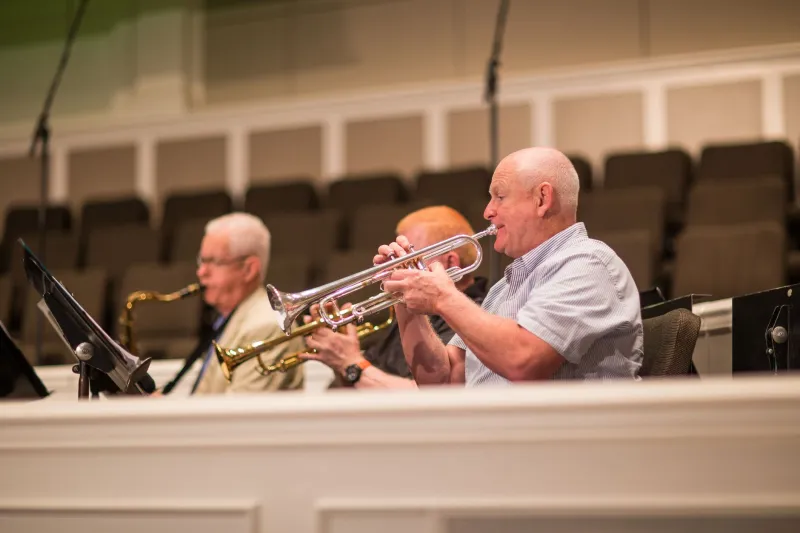
Community bands and orchestras. These are often the most welcoming entry points for adults. They typically rehearse weekly, prepare a concert or two per season, and range from very casual to surprisingly polished. Some have auditions; many do not. Ask about seating and part assignments before you commit. A group that rotates parts or offers simplified options can be a better fit than one that expects everyone to sight-read at tempo.
Adult group classes. Community music schools around Boston, including the Community Music Center of Boston and Brookline Music School, run adult group classes in everything from beginning strings to ukulele to jazz improvisation. These are structured like lessons but with a social component. They are ideal if you want instruction alongside ensemble experience.
Low-stakes jams. Folk, bluegrass, ukulele, and old-time jams tend to run on a come-as-you-are basis. The etiquette is usually simple: call a tune, take a solo if you want one, or play quietly and listen. These are great for adults who want to build confidence without a formal rehearsal schedule. They are less great if you need explicit instruction.
Chamber groups and small ensembles. Some adult beginners find a trio or quartet through a music school matching program or a neighborhood listserv. These groups can be lovely and low-pressure, but they require more self-direction. You need to be comfortable saying, I can play this slowly or I need to simplify this part.
What directors actually expect
Directors of community ensembles are usually less worried about your resume than about your reliability and attitude. They expect you to show up, count rests, mark your music, and ask questions when you are lost. They do not expect you to play every note perfectly. They do expect you to be honest about your level so they can place you appropriately.
A few practical questions can save weeks of confusion:
- Is there an audition, or is placement by conversation?
- What is the typical rehearsal pace?
- Are there simplified parts or transposed options?
- How many absences are acceptable before a concert?
- Is there a minimum playing level, or is beginner genuinely welcome?
The answers will tell you more than the website does. A group that says we welcome beginners but then hands out a grade-six piece at the first rehearsal is not lying, exactly. It just has a different definition of beginner.
How to choose a fit in Boston
Start with geography and schedule. A great ensemble across town on a weeknight is a terrible ensemble if you cannot get there after work. Look at community music school bulletins, neighborhood listservs, Boston Public Library event calendars, and bulletin boards at local music stores like Mr. Music in Allston. Church newsletters and community center flyers still carry useful leads. Cambridge Center for Adult Education and New England Conservatory’s continuing education offerings are worth checking for adult classes that feed into ensembles.
Then think about repertoire and culture. Do you want to play concert band marches, string orchestra warhorses, folk songs, or jazz standards? Do you want a director who gives detailed corrections or one who keeps the room moving? Do you want a post-rehearsal beer crew or a head-home-immediately crowd? None of these answers are wrong. They just need to match.
The trial rehearsal: a checklist
Most groups will let you sit in for one rehearsal before committing. Treat it like a test drive. Bring a pencil. Sit near the back or near a strong player. Ask the person next to you how long they have been playing. Notice whether the director explains things or assumes everyone already knows. Notice whether the room feels tense or loose. Notice whether you leave wanting to come back.
You are allowed to be a beginner in public. You are allowed to play wrong notes. You are allowed to ask for help. The second rehearsal is almost always easier than the first, and the third is easier still. Boston’s adult music community is not a closed club. It is a bunch of people who decided that starting late was better than not starting at all.