The Hallway Is the Rehearsal Hall: A Boston Sibling Guide to One Practice Corner
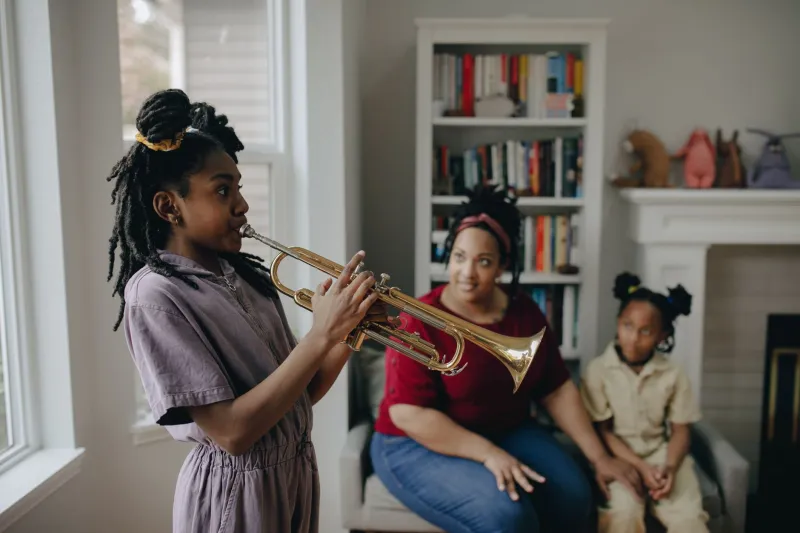
Boston apartments are excellent at many things: radiators that clank like a rhythm section, front stairs with perfect echo, and bedrooms that are also offices, guest rooms, and — somehow — practice studios. Add two young musicians and one shared corner, and the daily question becomes less about talent than traffic control. The good news? You do not need a soundproof bunker. You need a schedule, a few soft surfaces, and a sibling treaty that everyone can live with.
Start With the Calendar, Not the Couch
Most families try to solve a space problem with stuff. The first fix is usually a schedule. Pick two or three practice windows that repeat weekly: before school, right after school, and the post-dinner slot that everyone pretends is not the only free hour. Keep blocks short. A focused 25 minutes beats a resentful 55, especially when someone else is waiting with a trumpet.
Use one shared calendar — paper on the fridge is fine — and color-code it. Give each kid a say in which slot is 'theirs' for the week, then rotate the prime time so nobody permanently gets the after-school window. If one child has an audition coming, that student gets first pick for two weeks. Call it temporary, and mean it.
Parents: your job is air traffic control, not artistic direction. Announce the handoff five minutes early. 'Violin lands at 5:25' is more useful than 'hurry up.'
Sound Control Without a Contractor
Boston's older buildings leak sound through doors, floors, and the mysterious gap under the radiator. You are not trying to make the apartment silent. You are trying to take the edge off repetition so neighbors do not learn your kid's scales better than your kid does.
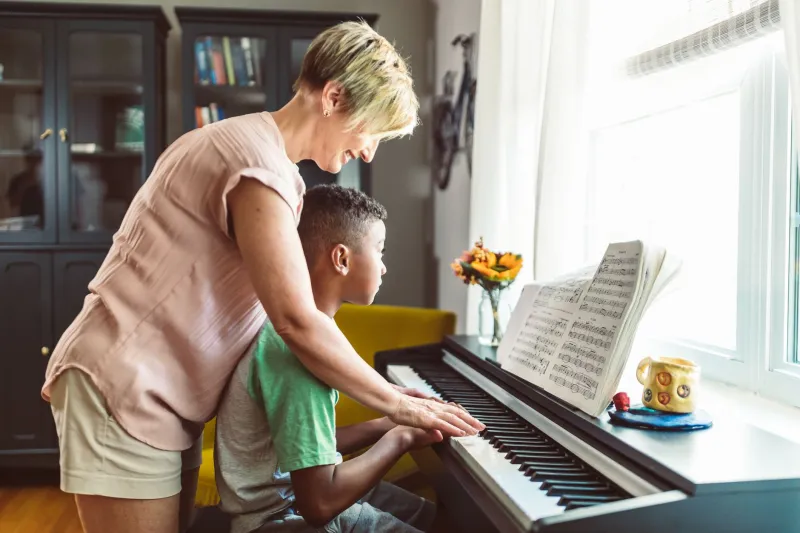
Start cheap: a door sweep, weatherstripping around the frame, a thick rug, and a moving blanket hung or draped in a corner. Bookshelves act like bass traps. A closet full of coats is a perfectly respectable vocal booth. For brass, a practice mute changes the feel, so use it for half the session and let the open horn have the other half. For drums, practice pads and low-volume cymbals are non-negotiable in apartments. A digital piano with headphones can be a marriage saver.
Talk to the neighbors before the first winter, not after the third noise complaint. A short note with your number and a rough practice window buys more goodwill than any foam panel. If someone works nights, adjust. Boston is dense; courtesy is infrastructure.
Storage That Survives a New England Winter
Winter is the quiet enemy of shared instrument storage. Forced-air heat dries out wood and cracks seams. Radiators are not shelves. Basements are not storage units. Keep instruments away from exterior walls, radiators, and sunny windows. Aim for 40 to 50 percent humidity with a cheap hygrometer, and use case humidifiers for strings and wooden instruments.
Think vertically. Wall hangers for guitars and ukuleles free floor space, but only if the wall is secure and the instrument is not in a high-traffic hallway. Hard cases live under beds or on a closet shelf. Label every case, cable, and music stand with a kid's name; otherwise the shared space becomes a lost-and-found. Keep sheet music in one binder per ensemble, not in a drifting pile.
Music stores around Boston will check setups, replace pads, and sell you a case that actually fits. Ask before you buy online. A local repair bench can save a rental instrument from a cracked winter.
The Sibling Treaty
Turf wars rarely start over the space itself. They start over timing, volume, and the sense that one kid's practice always matters more. Write down four rules and post them: one person practices at a time unless both agree; headphones are required for amplified instruments; no unsolicited critiques from the audience; and the person waiting gets the quiet side of the room.
Give each musician a 'home base' — a shelf, a stand, a corner — and a shared zone that stays clear. Use a timer. When it rings, the next person gets the space without a debate. If both need to rehearse on the same night, split the session: one works on repertoire while the other does theory, sight-reading, or listening homework with headphones.
Some siblings genuinely like practicing together. Let them try a duet once a week. It turns competition into a shared project, and it gives the apartment one hour when the noise is supposed to happen.
When the Apartment Wins
Even good systems break during audition weeks, school concerts, and snow days. Have a backup list: school practice rooms, community music school rooms, church choir lofts, and library study rooms that can be reserved. Call ahead; not every space is open to the public, and policies change. A half-hour rental in a nearby studio can rescue a week.
Finally, stop aiming for a perfect practice palace. Aim for a practice habit that survives the apartment. If the corner is small, the schedule is clear, and the siblings have agreed on the rules, the hallway can be a rehearsal hall. It just needs a door sweep and a little diplomacy.